
Today is Bill’s Birthday
Today is Bill’s birthday. He would have been 67 today.
We would most likely have gone out to eat as that is how we usually celebrate. He would have enjoyed that.
He would have spoken to his mother and his children and his grand children. He would have enjoyed that as well.
He would have written something in his BLOG and received a bunch of facebook Happy Birthdays on his two facebook pages. He would have enjoyed that as well.
Plans are underway for June 15th – the Celebration of Life. 1:30 at the Entler Hotel, in Shepherdstown.
I am looking forward to celebrating his memory. We are all connected and better for having spent time with Bill. Let’s raise a glass to Bill Tchakirides.
June 15th, Celebration of Life for Bill Tchakirides
Save the date, June 15th. Please join Bills friends and family for a “Celebration of Life” for Bill Tchakirides at the Entler Hotel, in Shepherdstown, WV. at 1:30. Please rsvp Ellen Smith esmithart30@gmail.com or 301.467.9516. We are looking forward to recalling his wonderful energy and zest for life.
William “Bill” Louis Tchakirides, May 24, 1946 – April 27, 2013
Bill Tchakirides age 66, retired, of Shepherdstown, West Virginia died peacefully Saturday, April 27. Bill was born May 24, 1946 in Waterbury, CT, the son of the late William Tchakirides and Doris (Barsale) Tchakirides, formerly of Bristol and Farmington, CT, now residing in Manassas, VA. Bill is survived by his wife Ellen Louise Smith of Shepherdstown, WV and by his children Cassandra Corrigan and husband Matthew Corrigan of Manchester, CT; Penelope Cantor of Williamsport, MD; William “Buddy” Tchakirides and wife Rachel Neal-Tchakirides of Milwaukee, WI; five grandchildren, John, Milo, Jason, Aden and Jacob; his sister Ellen Forbes Gerhard and husband Jeff Lychwick of Gainesville, VA and several nieces and nephews.
Bill was proud of being a father, a grandfather and a liberal. He was an artist and a patron of the arts. Of the baby boom generation, he worked as a Stage Director, Network Manager, College and Prep School Teacher, Lighting Designer, Computer Geek, Broadway Producer, Justice of the Peace, Theatre Electrician, Commercial Photographer, Non-Profit Administrator, Publisher, Playwright, Usability Tester, and as a Tour Guide in a Cape Cod Candle Factory.
In his retirement Bill played around in community theatres, designed and sold fonts for desktop publishing (UTF Type Foundry), wrote a blog, walked the dogs, helped his wife with the community garden in Shepherdstown, wrote reviews of the plays featured in the Contemporary American Theatre Festival and hosted or co-hosted two weekly radio shows. An engaged citizen, Bill supported the Sustainable Shepherdstown initiative, followed the democratic process and featured opinions and essays on his blog: https://underthelobsterscope.wordpress.com
Family will receive friends on Thursday, May 2, at Minnich Funeral Home, Hagerstown, MD. From 6-8:00 pm. A celebration of life will be held in the very near future. Memorial donations in his memory may be made to WSHC c/o Shepherd University Foundation, P.O. Box 5000, Shepherdstown, WV 25443 or Fine Arts Work Center, 24 Pearl Street, Provincetown, MA 02657.
Bill Tchakirides is in Hospice Care
I am updating this page with some sad news. It is very difficult and I do not like putting this on a public social media page – it seems disrespectful – however I know there are of friends of his who will look at this and this is the only way to share the updates with them.We also cannot get into his email so there may be friends that he was emailing who we cannot reach and we do not have anyway to email them for him.
Bill has been in hospice care for several weeks now. An additional tumor was found and so he was unable to continue the treatments for the brain tumor.
He is sleeping well most of the time. He is eating very little and drinking very little. His daughter Penny and I are keeping him comfortable and pain free. Hospice services are a wonderful thing and they are truly wonderful compassionate people to work with at Washington County Hospice.
Update on Bill –
It has been three weeks since we last visited our dogs in Harper’s Ferry, WV. For the last three Sundays, the dogs have had to come to visit Bill. They are a bit confused, as is Bill.
Penny and I cannot get out much, as someone has to be with Bill at all times. Friends and family have been kind enough to visit us, play music, just talk, sit, and to even bring our dogs to us. I feel like we are surrounded by wonderful compassionate souls.
Bill continues to rest comfortably and he appears to be in no pain. He has moments when he is aware of his surroundings and what is going on. At those times, he struggles to maintain his connection to the world. He enjoys music, especially Les Miserable, and eating oranges, pineapple chunks, and cashews.
Ellen
An Update on Bill’s Condition
Hello – I am updating this blog for Bill. He has tried to do his own update but has not been successful at this point.He is sitting here comfortably, watching MSNBC keeping up with what is going on in the political world. His son Will is visiting and we are at his daughter Penny’s house. I have plans to go to get our dogs to bring them to visit Bill tomorrow.
Things have progressed rapidly in his health and we have no choice but to share something with his readers. Over the years, this BLOG has been a mainstay in Bill’s life. He has enjoyed writing it and sharing it with his readers as well as visiting other related BLOGs and has developed a true community. This has been a truly wonderful part of Bill’s daily existence.
He followed through valiantly in his chemo and radiation for the brain tumor. The four week MRI showed that the tumor did shrink considerably. However he also has been diagnosed with an additional tumor. We are told it may be from the throat, neck or lymph nodes. The tests to find out exactly where are not very comfortable. To radiate the new tumor and do two different chemo-therapies at the same time would severely tax a younger, healthier person… so Bill has entered the Hospice Program of Washington County.
His daughter Penny and I are doing all that we can to make him comfortable. Relatives and friends are coming to visit. I know this BLOG reaches all over the globe. If you are in our geographic area and would like to visit, please plan to do so.
He enjoys very short visits.
If you have his email feel free to contact him or send a card. I am not sure whether Bill is answering all his direct emails or face book messages at this point. My email is esmithart30@gmail.com. I will give you the mailing address for cards and local directions.
Please keep him in your thoughts and thank you all for the cards and kind wishes that have been sent our way.
Ellen (Bill’s wife)
Bill and Ellen are now at home in Williamsport, MD
Hello – I am updating this page for Bill. We are in our second week at Bill’s daughter Penny’s house in Williamsport, MD.
It has been quite a change and adjustment for us. We had to change our doctors and activities from Frederick, MD to Hagerstown, MD. Bill does need someone with him at all times since he is a fall risk. He has completed 20 sessions of radiation and 20 days of chemo. When the Chemo and Radiation are complete, we will have to wait two more weeks. Then they will do an MRI to see how he has responded. He is enjoying Penny’s cooking, and watching cable TV. He misses his dogs and friends and posting to his BLOG. I hope he will be updating this BLOG himself soon!
Ellen
Looking for a new direction via my blog…
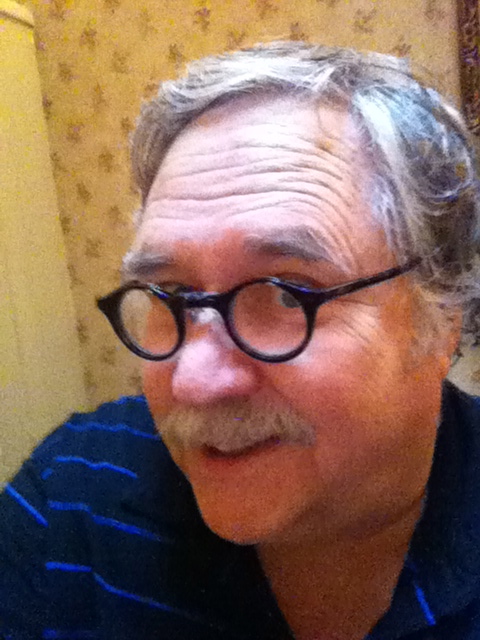
He hasn’t changed his look much, but he is more and more in revision of the views and and vestiges of UndertheLobsterScope@wordpress.com.
Here if is… nighttime in his hospital and related nursing home in Frederick, Maryland… and I am still in an utter depression and still have a long way to go to get what was my life back.
From Bill
Hi folks. I am not in a writing mode yet. My friends Linda and Cecil are visiting me in a new rehab called College View in Frederick, MD. Tomorrow I will be starting radiation and chemo. I would thank all my DJ friends from WSHC – Bobbie and Oinkie, Colin Voight and John Case who brought me a wonderful huge tub of Chili.
More updates to come.
– Bill
Bill is interested in having visitors now!
Bill is now in the Candlewood in Shepherdstown, working on his rehab. He will be going home to his daughter Penny’s house soon. Bill has done pretty well these last three or four days. He is more alert, can stand, walk, and looking forward “to getting out of this place” soon.
He says he would like to see some of his friends now. I am really pleased that he is feeling up for this. I think it is a very good sign. He is in The Candlewwood at 80 Maddex Rd in Shepherdstown. His cell phone number is 301.467.9607 There are no official visiting hours.
Thank you all for your good wishes and thoughts.
Ellen (Bill’s wife)
Bill is in Shepherdstown Again!
Hello – This is Bill’s wife again. He keeps saying he get get back on the BLOG but he gets tired and goes to sleep. So I am writing to let you all know that as of yesterday, he at the Candlewood in Shepherdstown. The address is 80 Maddex. I never knew it was here. It is tucked away just off rte 45 opposite the fire house, before you get to the Food Lion.
So he is sleeping alot and resting. The goal for the next two weeks is to do rehab to allow him to build stamina, walk a little, and to get in and out of a car. He is going to be starting radiation on Dec 17th in Frederick, MD. That will weaken him again. So we are also working on getting him strong with a “super-food” diet.
At the beginning of this nightmare, I was not able to say the words GBMIV Still can’t say it. Look it up if you wish to know more. However I started looking on the web for information, support sites , ways to get strong before the radiation begins, and other people seem to be able to talk about it. So I guess I can start.
Bill is still wary about the words. He has not started to research it. He has very little stamina and sleeps alot. I keep asking him if he wants visitors, and he says he does not. Maybe give him another day to get used to being here. He will answer his phone. His voice is very soft but he is speech is much improved.
Ellen
Update on Bill
Hello – Bill is eating and talking and smiling and communicating well.
Next step is rehab. He hopes it won’t be longer than a week. He is eager to get back to the radio and writing this blog.
Bill hopes that next update he can be the one posting it.
Ellen Smith (Bill’s wife)
Update on Bill
Hello all,
This is Cassandra, Bill’s oldest daughter. I just want to keep you updated on my Dad’s progress. He made it through surgery and is now sedated and resting comfortably in the ICU. Thank you for all your kind thoughts and posts, I can tell from watching him sleep he can’t wait to get back to his blog. Hopefully he will be the next one to update you.
/Cassandra
OK… next step.They are going to get me ready for surgery.
Hope this doesn’t take long…. I don’t really want to be knocked out for a long time. It’s my right brain that this tumor is on and I hope when they take it out I’ll still have mind enough to do this blog…an activity I am unusually fond of.

I guess I’ll be signing off now. I’ll try to get back up tomorrow or Sunday. – Bill
In the hospital waiting for an EKG…
 Surgery this afternoon, but they decided I needed another EKG this morning. I guess they think the old fat man is going to stop breathing and they want to cover their ass.
Had a no sleep night in the Georgetown Hotel. I’ve been fasting since last night and they won’t even let me drink water.
Cassandra is pushing me around in a wheelchair and Elly is on the phone. I sit and wait.
Hope you have a wonderful day.
Harold Kepnes, my friend, has died. I’m very sad.

Harold S.Kepnes, 1947 – 2012
He was a year younger than me, but we were both in the Class of ’64 at Tabor. Harold was my best friend and in the summers, when I worked on Cape Cod at the Candle Factory doing tours, Harold, who lived close by in Hyannis, had the home I hung out in.
Harry and Billy… that was how everyone knew us… wandered the Cape, went to drive-in movies, chased girls and hung out at his family’s private chunk of Craigville Beach. Even when I went off to college in Illinois and Harold went off, too, we would get back together in the summer.
Harold was the kind of friend you didn’t have to see in years and yet nothing changed. You don’t get many like that.
He spent the last couple of years fighting pancreatic cancer… in and out o9f hospitals and with the caring support of his wife, Monica, and his daughter, Caroline, who came in from California to be with her Dad. Caroline, a television writer of talent, has been keeping everyone informed about Harold and his condition.
Now he has died at age 65 and I shall miss him. What awful news to get from Monica this morning as I packed for Georgetown Hospital.
Packing for the hospital…
 I have to get to my daughter’s house before 10 AM with all my clothes and meds packed to get down to Georgetown to the hotel by the hospital. I’ll bring my laptop and hopefully I can review the news or arts events and have another post for my friends later.
My thoughts are all tied up with this brain surgery and I’m not even exploring the Susan Rice SOS nomination… something I would ordinarily be dwelling on. Or Netanyahu‘s new attack on Gaza which is likely to bring us even farther into Middle East hostilities. You’ll have to trot around to the sites I regularly quote to keep up with everything.
Soooo…Have a nice day and occasionally think of me. -Bill
Related articles
- Israeli military, Gaza militants trade fire (sfgate.com)
- Israel aircraft strike Gaza Strip; Netanyahu warns of major confrontation (vindy.com)
- Israel strike on Gaza sets stage for new phase of long running conflict (telegraph.co.uk)
- US defends Israeli attacks on Gaza at emergency UN meeting (dawn.com)
- 3D camera for brain surgery a big leap forward (thestar.com)
Artist Will Barnet dies at 101…
Will Barnet, a titan of the visual art world, died at his home in New York on Tuesday. He was 101.
 His family said the cause of death was old age. “He died peacefully in his home,” said Phil Alexandre of New York’s Alexandre Gallery, which represented Barnet.
Barnet, an art educator and a lifelong champion of the arts, inspired generations of artists and lived long enough to enjoy many honors that most artists receive only posthumously. In 2011, President Obama awarded him the National Medal of Arts, the highest honor for an individual artist in the United States.
This year, France recognized him with the insignia of Chevalier of the Order of Arts and Letters.
Barnet and his wife, Elena, lived in a duplex at the National Arts Club on Gramercy Park in Manhattan. They were without power for a few days because of Superstorm Sandy, and had to move to a warmer apartment.

“Woman Reading” by Will Barnet
Barnet got “a touch of pneumonia” during the power outage, Alexandre said, but had been feeling better in recent days.
His daughter, Ona, said her father visited many art galleries on Saturday, “doing what he loved the most.”
Hard of hearing and unable to walk, Barnet never allowed his physical ailments to limit his love of art, said a longtime friend, Ira Goldberg, executive director of the Arts Students League of New York, where Barnet studied and taught.
He was as committed to his work at 101 as he was when he was a young man making his way in New York, Goldberg said.
Barnett was probably best known for paintings and prints of women with their cats.
[thanks to the Portland (Maine) Press Herald]
Related articles
- Will Barnet, Painter, Dies At 101 (huffingtonpost.com)
- Will Barnet is dead (twocoatsofpaint.com)
- Cat & Art 21 Will Barnet (slideshare.net)
- Will Barnet, renowned painter with Maine ties, dies at 101 (bangordailynews.com)
Starting the day in Hell…
Last night, on our way home from the MRI, we stopped at my daughter Penny’s to pick up our dogs where they  were staying all day. Getting out of Cassandra‘s car and walking toward her house, I tripped over the base of my grandsons’ basketball net… painted black and invisible at night… and fell hard on the driveway and impacted my already weakened left side.
Getting up off the ground required really focused assistance from Elly and the girls who brought out a dining room chair for me to pull myself up using my right arm. This took about fifteen minutes and made my girls worry a lot.
While I don’t seem to have broken any bones, nor did I open any of the breaks I had in August/September, but my right arm hurts too much when I try to lift it that I’m really worried about what they are going to try to do at today’s exam in Hagerstown.
I spent the night switching between ice packs and a heating pad on my left shoulder and I have a little more movement, but not much, this morning. Elly made me a new ice pack for the morning.
I hope this doesn’t have the effect of cancelling Friday’s surgery on my head.
Just finished my MRI…
 Elly and Cassandra say I had a seizure going into the test… apparently I was “babbling”…but I don’t remember it. I was under the MRI’s spell for about an hour. Now we are having dinner and getting ready to drive back home.
They have added 2 more doctors appointments in Hagerstown tomorrow. There goes my last day off. I’ll be glad when the brain surgery is all over with this weekend.
Posting from my iPhone is a new experience for me. These fat fingers on a teensy keyboard really means not much writing. Sorry.
Down at Georgetown having lunch before tests…

Georgetown Hospital
If you ever have to do something at Georgetown University Hospital, let me recommend a wonderful on-campus restaurant, Empire and Company, a great classic buffet with a side pizza parlor.
We arrived an hour and a half early leaving time for my wife, daughter and me to have lunch and discuss this afternoon’s tests and what we are required to bring with us. I’ll do a blood test just before we go over and see if I need any insulin before the tests.
I’d like to thank all of you e-mailers and commentators and friends for contacting me and wishing me well and praying for me (can you believe it, an old, publicly avowed atheist like me?). I probably won’t be back to this until much later tonite or tomorrow morning, my last day at home this week. I’ll be back with a report on what’s going on.
Meanwhile, General Petraeus may be off the news and we can get back on to the economy.
Related articles
- Expert: Petraeus Scandal Revelations ‘Damaging Politically’ to the FBI (voicerussia.com)
- Bono To Deliver Keynote Address on Social Movement at Georgetown Monday (washington.cbslocal.com)
to my more conservative readers…

Pardon the Header  … it relates to my Tattoo stories.
Related articles
- Our Readers Show Off Their Dog Tribute Tattoos (dogster.com)
- Permanent Makeup: Do or Don’t? (dailyglow.com)
OK… it’s off to Georgetown today for the last day of tests before surgery…
Something called “Pre-Surgical Intake” and ending with a new MRI. Then we’ll be chugging back to Harpers Ferry, I get a day off and on Thursday night I’m back in Georgetown at the hotel next to the hospital waiting to have a hole drilled in my head the next day.
Looks like we’ll be driving down in the rain.
I can’t say this is the week I’m looking forward to, but if it ends up solving the problem of  my seizures and other things and I am allowed to drive a car again someday (that’s something a guy who goes around to visit friends really misses!) and maybe live a while longer who could complain?
Hey… a note to my wife… Let’s assume I’m going to make Christmas this year. Know what I want? The new DVD of the revival of Sondheim’s company with Neil Patrick Harris, Patty LuPone and… Stephen Colbert! You can get it at Amazon. Don’t order it until after Saturday.


 Under The LobsterScope